#66369 - Currents and Voltages

What do you think about the latest hot topic from the 100 Hour Board? Speak your piece here!

Moderator: Marduk

Post Reply
Fredjikrang
Never Coming Back?
Posts: 2031
Joined: Mon Apr 02, 2007 9:59 am
Location: Provo, UT
Contact:

#66369 - Currents and Voltages

Post by Fredjikrang »

Board Question #66369

So, does no one understand what I am asking? I thought I explained it pretty well, even listing examples that could be easily researched.

Maybe I should have just posted links to Wikipedia. . .

http://en.wikipedia.org/wiki/Current_source
http://en.wikipedia.org/wiki/Voltage_source

I never thought that such a simple question would have stumped the board. :-(
[img]http://fredjikrang.petfish.net/Fence-banner.png[/img]
User avatar
Defy V
Posts: 378
Joined: Mon Jan 17, 2011 9:58 am

Re: #66369 - Currents and Voltages

Post by Defy V »

Here I am, studying electrical engineering, and I am kind of struggling. I think I understand your question, but I don't really have a good answer. (I never paid attention much to this stuff.)
So here are some thoughts

~High voltage is better than high current when you're transmitting a long distance. Power can either be defined as I^2 R (where I is the current in amps and R is the resistance in ohms) or as V^2/R (where V is in volts). Thus, if you send high voltages with little current, the power loss is inversely proportional to R rather than proportional to R. Since R is hard to decrease (there's resistance everywhere), it's easier to make high-resistance systems than low-resistance systems. Since V^2/R power loss is better than I^2*R power loss, high voltages are sent. Since voltage and current are inversely proportional (V = IR), this corresponds to a low current. This voltage-source mentality probably continues up til the electricity reaches your electrical outlet. I don't know why LEDs are different.

~I just remember current being really hard to generate in labs. I wish I could remember why.

If you want someone more knowledgeable about voltage and current, Dr. Wilde or Dr. Comer in the EE department would probably be good to talk to. I doubt they'd mind.

And anyone who knows more, feel free to correct me. I was never particularly interested in circuits.
User avatar
Tao
Posts: 909
Joined: Fri Apr 20, 2007 3:37 pm
Location: All over the place

Re: #66369 - Currents and Voltages

Post by Tao »

I'm afraid part of the struggle is in simple terminology. Even pulling from the articles you linked "Since no ideal sources of either variety exist (all real-world examples have finite and non-zero source impedance), any current source can be considered as a voltage source with the same source impedance and vice versa." Oftentimes what something gets called is more a form of preference than any other matter. Also of importance is the overall circuit in making such a determination, a purely resistive circuit has voltage and current in phase, in a capacitive circuit current precedes voltage, and in an inductive current, voltages leads. Most circuitry outside of introductory classes aren't purely one of the three, so you have to make do with whatever your preferred approach may be.

I don't claim to be an expert by any means, my understanding of such matters may well be as far afield as any other nutcase, but your question came across to me akin to asking why we prefer to use pumps that push water more than we use pumps that pull water. The pumps are basically the same, but what part of the flow is important may be different for each.
He who knows others is clever;
He who knows himself has discernment.
He who overcomes others has force;
He who overcomes himself is strong. 33:1-4
Fredjikrang
Never Coming Back?
Posts: 2031
Joined: Mon Apr 02, 2007 9:59 am
Location: Provo, UT
Contact:

Re: #66369 - Currents and Voltages

Post by Fredjikrang »

I guess it is kind of that way, but I will try to explain how I understand the difference a little better. It is very possible that I am wrong, but this is how I understand it.

Using Tao's water pump analogy:

A constant voltage source would be like a pump that maintains a constant pressure on the system. For instance, if we connect such a pump to a sprinkler system, it would maintain the pressure (voltage) at, oh, 50 psi. This means that when the sprinkler system (circuit) is off, there is zero flow (current), because no water is running through the circuit (power being used), and when the system is off, the pump will push as much water as it has to (increase the current) to maintain that same pressure (voltage).

It would look something like this 30 second photoshop representation:
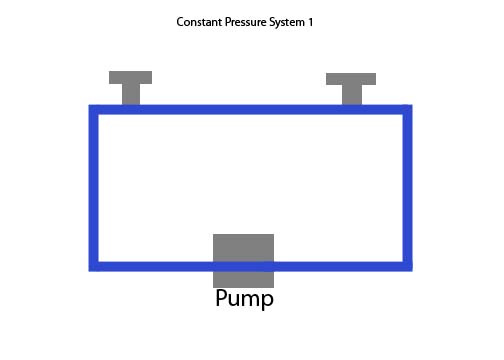
The constant pressure system 1.
cp1.jpg (24.69 KiB) Viewed 2804 times
(Please note: I modified the circuit a little bit to make it more similar to an electrical circuit.)

A constant current source would be a different kind of pump, that instead of trying to maintain the same pressure (voltage) always pumps the same amount of water. So, obviously this would have disastrous consequences on a normal sprinkler system, because if the system were off, it would increase the pressure (voltage) until something gives and the water could begin to flow. But a slightly modified sprinkler system could use this type of pump, where you would use a flow divider that only allows the needed flow (current) to go to the system, and the rest could be routed back to the input directly. This way when the system is off, the pump can still push it's desired flow rate, since it becomes a circular loop.

Or something like this:
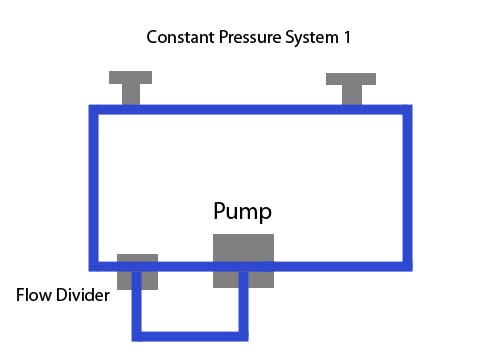
cf1.jpg
cf1.jpg (29 KiB) Viewed 2804 times
So, the constant pressure pump seems like the ideal choice, right? Let me see if I can think of another example.

Let's say that you have a marine aquarium with some very flow sensitive animals in it.

If you used a constant pressure (voltage) pump in this situation, then you need to monitor the flow rate, and provide some kind of way to ensure that it is what you want it to be, despite changing water heads, changing output sizes (encrustation, etc.) and any other number of variables. I can't even think of good example of how to do this. Probably because I don't understand exactly how to make a buck/boost regulator.

But, if you use a constant flow pump, you don't have to do anything. It will maintain that same flow rate, no matter what the environment does.

So, as I understand it, that is basically how it works. Some things you probably want to control the voltage, and some the current, but some, I really don't think that it matters very much.
[img]http://fredjikrang.petfish.net/Fence-banner.png[/img]
User avatar
Laser Jock
Tech Admin
Posts: 630
Joined: Sat Apr 14, 2007 4:07 pm

Re: #66369 - Currents and Voltages

Post by Laser Jock »

I just wanted to jump in here and say, Fredjikrang, that I understood what you meant both times you asked this question...but I wasn't the first to get to it, and I assumed the people who had partial answers when I looked did understand the question. Sorry. :) I haven't carefully thought about this just yet, but I can come back to this after thinking about it some more.
User avatar
Digit
Posts: 1321
Joined: Tue Mar 15, 2011 2:16 pm
Contact:

Re: #66369 - Currents and Voltages

Post by Digit »

I'm a computer engineer, not an electrical engineer, but I minored in EE, and from one class, I remember the teacher saying something along the lines of "Know how you can tell the difference between a Norton Equivalent (constant current) and a Thevenin Equivalent (constant voltage) circuit? Put your hand on the box. If it's warm, it's a Norton circuit." Meaning constant current circuits are always burning power because of the parallel impedance, which would seem to me to make them make your power bill higher.
Quod gratis asseritur, gratis negatur.
Post Reply