I guess it is kind of that way, but I will try to explain how I understand the difference a little better. It is very possible that I am wrong, but this is how I understand it.
Using Tao's water pump analogy:
A constant voltage source would be like a pump that maintains a constant pressure on the system. For instance, if we connect such a pump to a sprinkler system, it would maintain the pressure (voltage) at, oh, 50 psi. This means that when the sprinkler system (circuit) is off, there is zero flow (current), because no water is running through the circuit (power being used), and when the system is off, the pump will push as much water as it has to (increase the current) to maintain that same pressure (voltage).
It would look something like this 30 second photoshop representation:
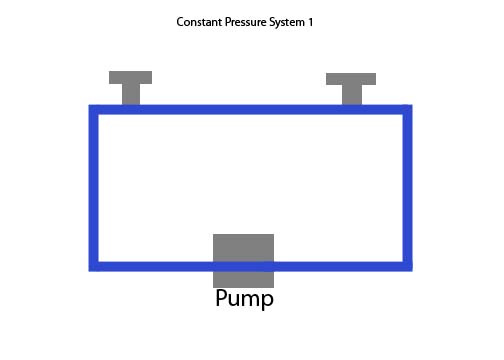
- The constant pressure system 1.
- cp1.jpg (24.69 KiB) Viewed 2799 times
(Please note: I modified the circuit a little bit to make it more similar to an electrical circuit.)
A constant current source would be a different kind of pump, that instead of trying to maintain the same pressure (voltage) always pumps the same amount of water. So, obviously this would have disastrous consequences on a normal sprinkler system, because if the system were off, it would increase the pressure (voltage) until something gives and the water could begin to flow. But a slightly modified sprinkler system could use this type of pump, where you would use a flow divider that only allows the needed flow (current) to go to the system, and the rest could be routed back to the input directly. This way when the system is off, the pump can still push it's desired flow rate, since it becomes a circular loop.
Or something like this:
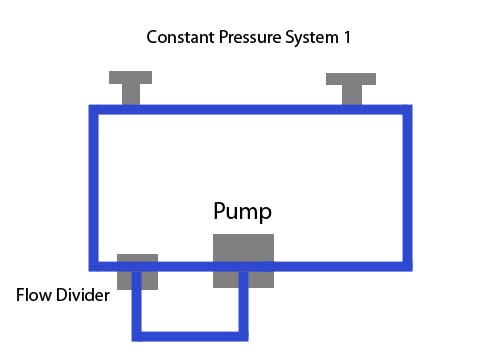
- cf1.jpg (29 KiB) Viewed 2799 times
So, the constant pressure pump seems like the ideal choice, right? Let me see if I can think of another example.
Let's say that you have a marine aquarium with some very flow sensitive animals in it.
If you used a constant pressure (voltage) pump in this situation, then you need to monitor the flow rate, and provide some kind of way to ensure that it is what you want it to be, despite changing water heads, changing output sizes (encrustation, etc.) and any other number of variables. I can't even think of good example of how to do this. Probably because I don't understand exactly how to make a buck/boost regulator.
But, if you use a constant flow pump, you don't have to do anything. It will maintain that same flow rate, no matter what the environment does.
So, as I understand it, that is basically how it works. Some things you probably want to control the voltage, and some the current, but some, I really don't think that it matters very much.


 I haven't carefully thought about this just yet, but I can come back to this after thinking about it some more.